
Microinverter vs string inverter: where module-level MPPT earns its keep.
Microinverters put a dedicated MPPT on every module; string inverters share one across the whole array. Here is where that difference pays, with GTB 400–1600 W specs from EMS-ESS.
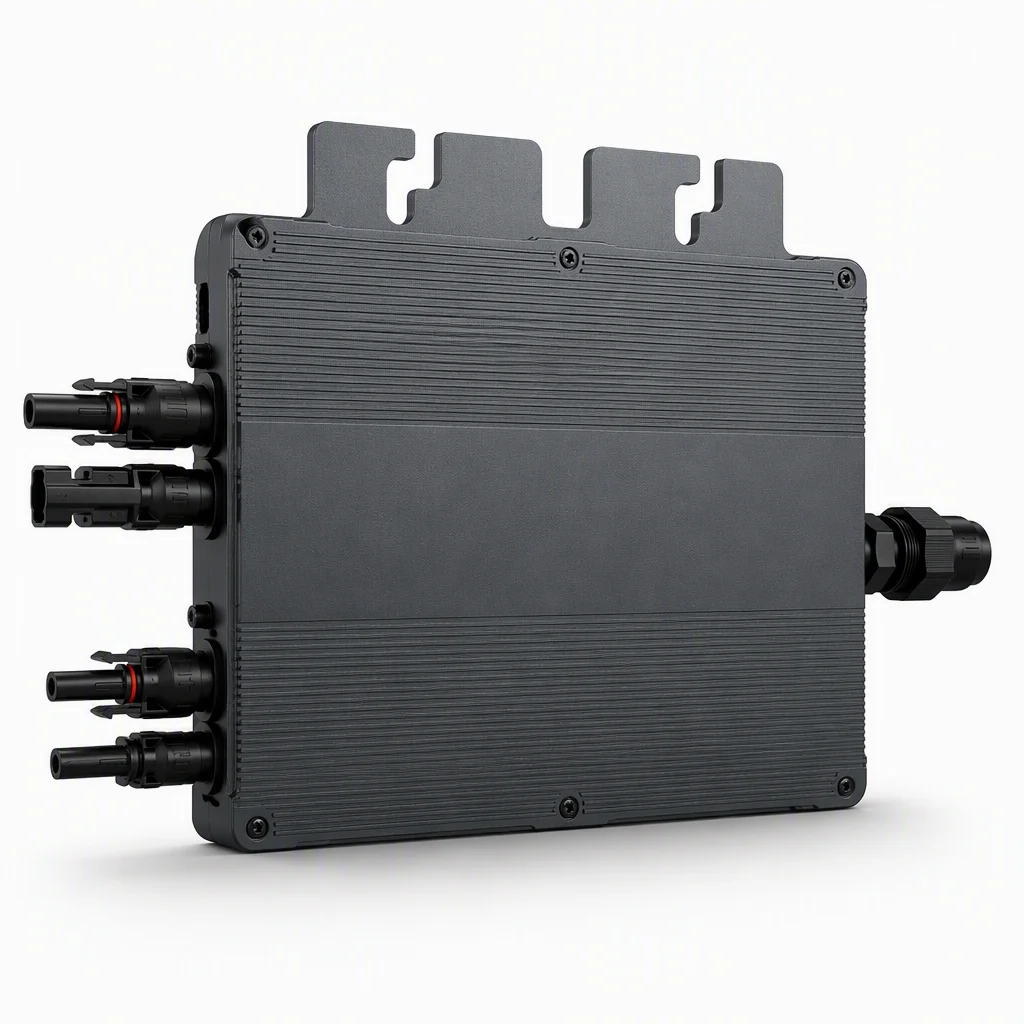
A string inverter joins every panel on a roof into one high-voltage series circuit and tracks them as a single unit. A microinverter does the opposite: one small inverter per module, each with its own MPPT. The two architectures cost differently and fail differently.
EMS-ESS sells the GTB grid-tie microinverter line from 400 W to 1,600 W for exactly the roofs where the string model underperforms — partial shade, complex orientations and step-by-step expansion.
Shade and mismatch: one MPPT per module.
In a string, every panel is forced to the current of the weakest one, so a single shaded or soiled module drags down the whole series. A microinverter isolates that problem: each GTB unit runs its own MPPT across 22–48 V, so each module produces at its own best point.
The GTB line scales the inputs to the module count. The 400 W unit takes one MC4 pair for a single 400 W panel; the 600 W and 800 W units take two pairs; the 1,200 W, 1,400 W and 1,600 W units take four. Mismatch loss that a string has to absorb simply never enters the equation.
Scaling and three-phase: 4 to 10 units per branch.
Microinverters also win on incremental growth. You add one unit per new panel instead of re-stringing an array. On a 230 V single-phase branch, the GTB 400/600/800 W units allow up to 10 inverters per branch, while the 1,200–1,600 W units allow 4 per branch because each carries more current on the same 20 A AC bus cable.
For three-phase sites, single-phase GTB units are grouped into PV Array A, B and C to form a balanced three-phase system. That flexibility lets a distributor cover both single-phase homes and small three-phase commercial roofs with one product family.

Safety and monitoring: IP65, fanless, WiFi + Bluetooth.
The GTB line is built for rooftop duty. Every unit is IP65, cooled by natural convection with no fans, and uses a high-frequency transformer that is galvanically isolated, with PE provided through the AC cable — no separate earth rod per module.
Monitoring is wireless. Each inverter reports over WiFi to the Smart Life app (Android and iOS), with Bluetooth pairing for setup and a cloud upload every minute. That gives installers per-module visibility a string inverter cannot offer.
- IP65 sealed, natural-convection cooling with no fans
- High-frequency isolated transformer; PE via AC cable
- WiFi cloud monitoring + Bluetooth pairing, Smart Life app
- Cloud status upload every minute
The GTB series, side by side.
| Parameter | GTB400 | GTB600 | GTB800 | GTB1200 | GTB1400 | GTB1600 |
|---|---|---|---|---|---|---|
| Rated output | 400 W | 600 W | 800 W | 1200 W | 1400 W | 1600 W |
| MC4 inputs | 1 set | 2 sets | 2 sets | 4 sets | 4 sets | 4 sets |
| Max input current | 12 A | 12 A ×2 | 12 A ×2 | 15 A ×2 | 15 A ×2 | 15 A ×2 |
| Paired PV | 1×400 W | 2×300 W | 2×400 W | 4×300 W | 4×350 W | 4×400 W |
| Weight | 1.2 kg | 2.45 kg | 2.45 kg | 3.5 kg | 3.5 kg | 3.5 kg |
| Dimensions (W×H×D) | 185×160×40 mm | 210×195×35 mm | 230×200×40 mm | 365×230×40 mm | 365×230×40 mm | 365×230×40 mm |
| Units per branch (230 V) | 10 | 10* | 10* | 4 | 4 | 4 |
| MPPT range | 22–48 V | 22–48 V | 22–48 V | 22–48 V | 22–48 V | 22–48 V |
| Peak efficiency | 95% | 95% | 95% | 95% | 95% | 95% |
| THD / power factor | <5% / >0.99 | <5% / >0.99 | <5% / >0.99 | <5% / >0.99 | <5% / >0.99 | <5% / >0.99 |
* The GTB600 and GTB800 spec tables list 10 units per 230 V branch, while the same pages' wiring notes list 8; the GTB400 (10) and the 1,200–1,600 W units (4) are consistent across both. EMS-ESS documents both values as printed in the manual.
String still wins for simple roofs; microinverters win for the rest.
A string inverter remains the cheaper choice for a large, unshaded, single-orientation roof. The GTB microinverter earns its premium the moment shading, complex geometry or phased expansion enters the picture — and it does so with total harmonic distortion below 5% and a power factor above 0.99, so the grid sees clean power.
The GTB line is built for grid compliance out of the box, designed to EN IEC61000-3-2:2019+A1:2021, EN 61000-3-3 and EN IEC55014-2:2021. See the full six-model table and per-unit datasheets on the microinverter page.
Ready for a distributor quote?
Send your roof layout, module count and grid type — our sales team replies within 24 hours on working days.