
Stop paying to export your own power.
Germany's wholesale market went negative on 11 May 2025, bottoming at minus €250/MWh. Under the Solar Peak Act 2025 (Solarspitzengesetz), negative-price subsidies are gone, so homeowners who export midday solar now lose money. Storing that surplus in LiFePO4 and releasing it after sunset is the fix: battery plus smart control lifts self-consumption from ~30% to ~80%.
Four numbers behind the storage switch.
Residential solar economics shifted in 2025. These four data points explain why storage stopped being optional for German rooftops.
| Pain point | What the data says |
|---|---|
| Negative prices | German wholesale electricity fell to a low of minus €250/MWh on 11 May 2025, and net end-customer prices went below zero for the first time (pv magazine, May 2025). |
| Feed-in cuts | The Solar Peak Act 2025 removes negative-price feed-in subsidies and pushes PV owners toward self-consumption and storage (Apollo Solar). |
| Low self-consumption | Battery plus smart control raises solar self-consumption from ~30% to ~80% (Werner Solutions). |
| Upfront cost | A single-battery partial-backup installation runs roughly $12,000–$16,000 before incentives, as of May 2026 (SurgePV). |
Size the battery to the bill, not the array.
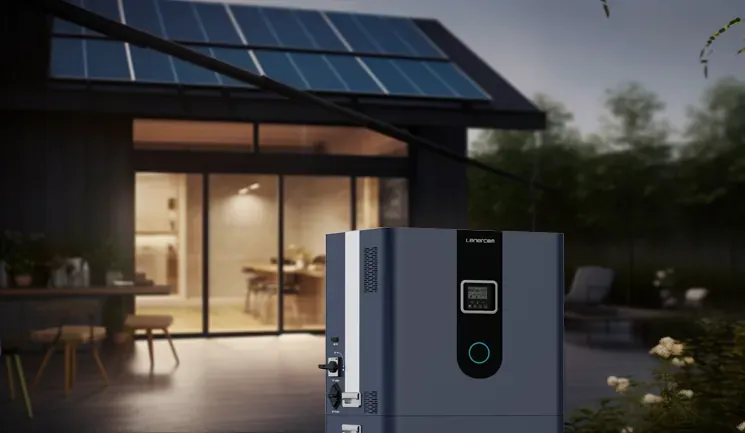
A residential system that only chases daytime export leaves money on the table. EMS-ESS pairs a 3–12 kW hybrid inverter with 5.12 kWh LiFePO4 modules that stack from 5.12 to 30.72 kWh, drawing from PV, grid and diesel. During negative-price hours the controller stops exporting and charges instead; after sunset it discharges at 93% round-trip efficiency on the 3–5 kW line, or 98.2% on the 8–12 kW line.
- 10 ms switchover (UPS, VDE) keeps lights on through grid drops
- 90–280 V wide input holds constant output on unstable grids
- One 5.12 kWh cabinet expands 1–8 modules to 30.72 kWh
- VDE-AR-N 4105 German grid-connection certification
How residential requirements map to EMS-ESS.
Every buyer requirement below maps to a specific, certified product parameter — no custom engineering needed.
| Requirement | EMS-ESS response |
|---|---|
| System choice | 5 kW single-phase (5.12–30.72 kWh) for typical homes; 8–12 kW three-phase for larger PV arrays |
| Power range | 3–12 kW hybrid inverter; single-phase 3–5 kW, single/three-phase 8–12 kW |
| Capacity | 5.12 kWh LiFePO4 module, expandable up to 5 modules (5.12–25.6 kWh) |
| Switchover time | 10 ms (UPS, VDE); 20 ms (APL) |
| Input voltage | 90–280 V wide input, constant-voltage output (single-phase 176–270 V) |
| Battery | LiFePO4, 100% DOD, 10-year design life |
| Efficiency | 93% charge/discharge (3–5 kW); 98.2% (8–12 kW) |
| Grid standard | VDE-AR-N 4105, G99, EN 50549-1, EN 62116 |
| Certifications | CE, IEC 62109-1&-2, IEC 62477, UN38.3 |
| Installation | ~5 min tool-free stacking, IP20 indoor, −15 °C to 55 °C |
| Warranty | 5-year product + 10-year performance warranty |
| Monitoring | APP + EMS cloud with remote fault diagnosis |
From inquiry to a running system.
System selection
Share daily kWh, peak load, PV size and grid type. We match a 3–12 kW system and an expansion plan — usually within one working day.
Grid files & samples
Test a sample against your local grid code. We deliver CE, IEC 62109 and UN38.3 files, English manuals and packaging specs for approval.
Install & maintain
Tool-free install in about 5 minutes, then APP + EMS cloud handles remote diagnosis. Warranty runs 5 years product, 10 years performance.
Verified facts behind the residential line.
- Home storage passed German VDE 4105 grid-connection certification
- Delivered the EMS for the world's first 100 MW-class multi-energy platform (Changde, RMB 160 million investment)
- Distribution channels established in 20+ countries, with a German branch office
- CE, IEC and UN38.3 certification across the storage product line
Store it. Don't export it.
Send your market, PV size and daily load profile. We return a self-consumption plan and a VDE-4105-ready quote within one working day.