
Charge the car on yesterday's sun.
An electric car usually charges in the evening, exactly when rooftop solar has stopped producing and grid prices are at their peak. The answer is to store daytime PV and release it at the charge session — a use case EMS-ESS explicitly supports as standby power for electric-vehicle charging. On negative-price days like Germany's minus €250/MWh on 11 May 2025, storing instead of exporting is the difference between profit and loss.
Four costs of peak-time charging.
Demand charges, wasted solar, peak-rate grid draw and negative-price export define the EV charging problem.
| Pain point | What the data says |
|---|---|
| Demand charges | Demand charges are the dominant cost problem at DC fast-charge sites; battery storage is the standard mitigation (AMpeco; Electric Era). |
| Wasted solar | The product brief lists standby power for electric-vehicle charging among supported scenarios (EMS-ESS residential ESS). |
| Utility upgrades | Battery-backed EV charging buffers the grid and avoids costly utility upgrades (PandaExo). |
| Negative prices | On Germany's minus €250/MWh days (11 May 2025), exporting PV is worthless; storing it and charging the car after dark is the better use. |
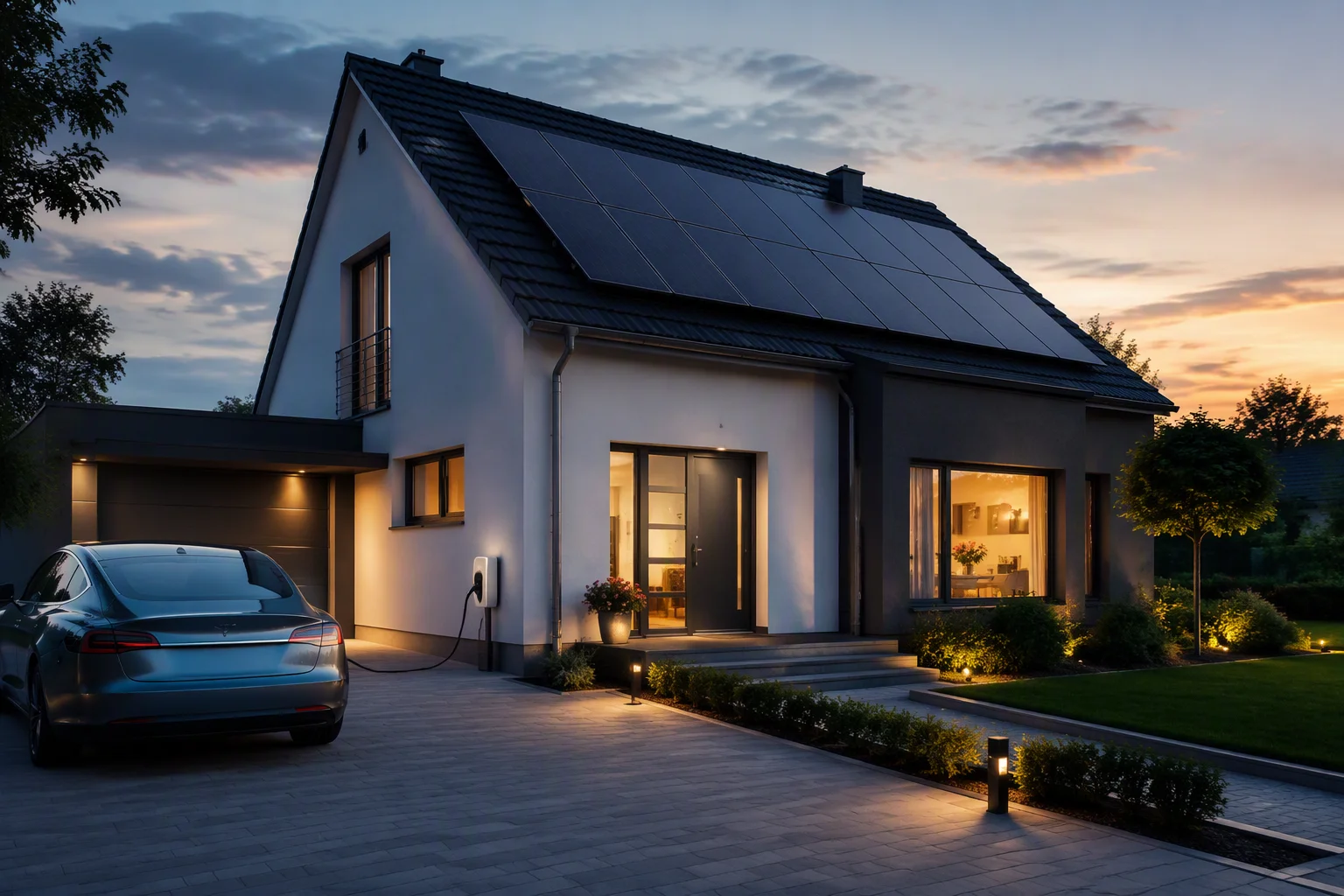
Shift the charge, not the habit.
The driver plugs in at the same hour every day; the storage changes where the energy comes from. During the day the 8–12 kW hybrid inverter sends surplus PV into 5.12 kWh LiFePO4 modules (stacking to 30.72 kWh) instead of exporting at a loss. When the car connects, the system discharges that reserve through the charge point, so the session draws battery power rather than peak-rate grid power, and the site dodges the demand charge that a simultaneous charge-and-cool cycle would otherwise trigger.
- Standby power for electric-vehicle charging, per the product brief
- 5.12 kWh modules stack to 30.72 kWh for overnight charge sessions
- 10 ms switchover keeps the charge session live through grid drops
- Time-of-use scheduling charges on solar, discharges at peak
How EV charging requirements map to EMS-ESS.
Each charging-site constraint maps to a certified, install-ready product parameter.
| Requirement | EMS-ESS response |
|---|---|
| System choice | 8–12 kW hybrid with PV + EV charging standby; reserve stored PV for evening charge sessions |
| Power range | 3–12 kW hybrid inverter; single-phase 3–5 kW, single/three-phase 8–12 kW |
| Capacity | 5.12 kWh LiFePO4 module, expandable up to 5 modules (5.12–25.6 kWh) |
| Switchover time | 10 ms (UPS, VDE); 20 ms (APL) |
| Input voltage | 90–280 V wide input, constant-voltage output (single-phase 176–270 V) |
| Battery | LiFePO4, 100% DOD, 10-year design life |
| Efficiency | 93% charge/discharge (3–5 kW); 98.2% (8–12 kW) |
| Grid standard | VDE-AR-N 4105, G99, EN 50549-1, EN 62116 |
| Certifications | CE, IEC 62109-1&-2, IEC 62477, UN38.3 |
| Installation | ~5 min tool-free stacking, IP20 indoor, −15 °C to 55 °C |
| Warranty | 5-year product + 10-year performance warranty |
| Monitoring | APP + EMS cloud with remote fault diagnosis |
From inquiry to a solar-backed charger.
System selection
Share the charger power, session hours and PV size. We match an 8–12 kW hybrid and reserve plan — usually within one working day.
Grid files & samples
Test a sample against your local grid code. We deliver CE, IEC 62109 and UN38.3 files, English manuals and packaging specs for approval.
Install & maintain
Tool-free install in about 5 minutes, then APP + EMS cloud handles remote diagnosis. Warranty runs 5 years product, 10 years performance.
Verified facts behind the EV line.
- Product brief lists standby power for electric-vehicle charging alongside residential, apartments, shops, offices and laboratories
- Battery plus smart control raises solar self-consumption from ~30% to ~80% (Werner Solutions)
- Germany's wholesale price hit minus €250/MWh on 11 May 2025 (Green Building Africa)
- Distribution channels established in 20+ countries, with a German branch office
Charge on stored sun.
Send your charger power, session hours and PV size. We return a solar-backed EV charging plan and a quote within one working day.