
Shave the peak. Fit the room.
Multi-family buildings pay for the highest 15-minute spike, not just the kilowatt-hours they use — demand-charge peak shaving with battery storage targets exactly that cost. A storage unit that shifts load away from the peak and lifts self-consumption from ~30% to ~80% needs to be indoor-rated, quiet and small enough for a utility room or balcony, which is where EMS-ESS fits.
Four constraints on the multi-family bill.
Space, noise, demand charges and under-used solar define the apartment storage problem.
| Pain point | What the data says |
|---|---|
| Demand charges | Peak shaving with battery storage targets the facility demand charges that dominate commercial bills (Redaptive; Dynapower). |
| Low self-consumption | Battery plus smart control raises solar self-consumption from ~30% to ~80% (Werner Solutions). |
| Proof at scale | A 1 MWh BESS delivered measurable energy savings at a European agriculture plant (SCU Power case). |
| Space limits | Apartment utility rooms demand an IP20 indoor, silent, lightweight unit that installs in about 5 minutes (EMS-ESS product line). |
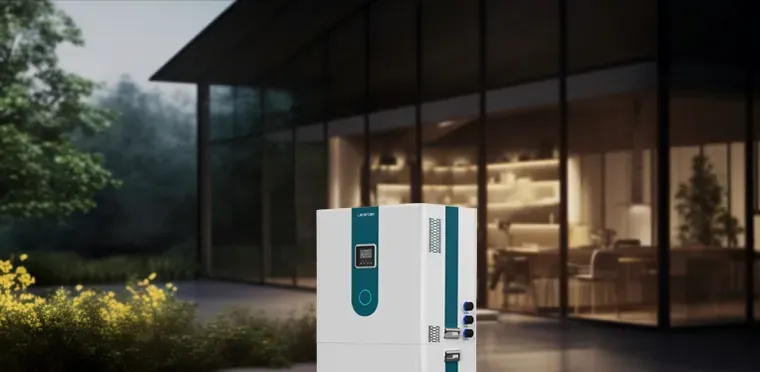
A battery that behaves like furniture.
The same 3–12 kW hybrid inverter and 5.12 kWh LiFePO4 module that powers detached homes works in multi-family, because the enclosure is IP20 indoor, fanless in operation and light enough for two people. Stack 5.12 to 30.72 kWh in a corner, wire three color-coded cables, and the system is running in about 5 minutes — versus 60+ minutes for conventional installs. Demand-response and time-of-use scheduling then move load off the peak and store cheap or solar power for it.
- IP20 indoor-rated, silent, lightweight enclosure
- About 5 minutes tool-free install, versus 60+ minutes typical
- 10 ms switchover and 90–280 V wide input for stable output
- APP + EMS cloud scheduling for peak shaving and time-of-use
How multi-family requirements map to EMS-ESS.
Each building constraint maps to a certified, install-ready product parameter.
| Requirement | EMS-ESS response |
|---|---|
| System choice | 3–5 kW single-phase for individual units; 8–12 kW three-phase for whole-building common loads |
| Power range | 3–12 kW hybrid inverter; single-phase 3–5 kW, single/three-phase 8–12 kW |
| Capacity | 5.12 kWh LiFePO4 module, expandable up to 5 modules (5.12–25.6 kWh) |
| Switchover time | 10 ms (UPS, VDE); 20 ms (APL) |
| Input voltage | 90–280 V wide input, constant-voltage output (single-phase 176–270 V) |
| Battery | LiFePO4, 100% DOD, 10-year design life |
| Efficiency | 93% charge/discharge (3–5 kW); 98.2% (8–12 kW) |
| Grid standard | VDE-AR-N 4105, G99, EN 50549-1, EN 62116 |
| Certifications | CE, IEC 62109-1&-2, IEC 62477, UN38.3 |
| Installation | ~5 min tool-free stacking, IP20 indoor, silent, lightweight |
| Warranty | 5-year product + 10-year performance warranty |
| Monitoring | APP + EMS cloud with remote fault diagnosis |
From inquiry to a running building.
System selection
Share common-load demand, peak kW and utility room dimensions. We match a 3–12 kW system and expansion plan — usually within one working day.
Grid files & samples
Test a sample against your local grid code. We deliver CE, IEC 62109 and UN38.3 files, English manuals and packaging specs for approval.
Install & maintain
Tool-free install in about 5 minutes, then APP + EMS cloud handles remote diagnosis. Warranty runs 5 years product, 10 years performance.
Verified facts behind the multi-family line.
- A 1 MWh BESS delivered measurable energy savings at a European agriculture plant (SCU Power case)
- IP20 indoor enclosure with ~5 minute install, versus 60+ minutes typical
- Distribution channels established in 20+ countries, with a German branch office
- CE, IEC and UN38.3 certification across the storage product line
Fit the room. Shave the peak.
Send your building's peak demand, tariff structure and utility room size. We return a peak-shaving plan and a quote within one working day.